Recently, I went to see a Rothko exhibit with my friend Adam. We were in Paris, and the city was gray and cold. On my way to the Fondation Louis Vuitton, I walked through a wooded area. I looked up, and there were pine trees. For a few moments, I couldn’t walk because I was so flattened by the sight of these enormous trees. They were bare of needles. The scaly bark was an ashen purple. The branches were dark as they spread out over the milky veil of the sky. I used to run through pine forests with my cousins. The pine tree is an indelible image of my childhood. But something about seeing them there, when I least expected it, thousands of a miles away from the pine trees of my youth, the trees which had been cut down to pay for booze and which would never be replaced, all this time and distance away from those lost trees, to have encountered them in Paris, my life so radically transformed, startled me. We went to the Rothko show. I was still thinking about those trees. When we arrived at a series of late gray-and-black paintings, I felt that Rothko had captured something true in my experience of the world. Amid the swirling gray field in the lower half of one of the paintings, I saw the shifting faces of those in the beyond— indistinct, but present. I do not mean that there were figurative aspects to the painting or even that the painting gestured toward the figurative at all. I also do not mean to say that there was anything in the painting that suggested I should have found some personal resonance in it. Yet, in that negative space, the painting felt extremely personal to me. Perhaps what I am trying to describe is not looking as such. But that in my looking at the subtly shifting bands of light and shadow in the abstract gray field of the Rothko paintings, I remembered very strongly how I felt when I watched my father’s cigarette smoke turn and billow or how I watched fire and smoke stream out of the burning barrels we used to dispose of trash or the shapes the wind made as it kicked up dust from the fields in late summer. What I felt then was perhaps a recognition for a prior state of looking, which belonged to a part of my life that has nothing to do with the way I live now or the person I am. The Rothko with its many shifting shades brought it all back, tumbling over me. In a moment like that, the strange and sudden overlaying of the past and the present brought on by just one painting, you can’t help but to think, Yeah, art can be an ethic. Art can be a moral universe.
Posted 6 days ago.

Happy Labor Day! Today is for me the fourth of a four-day weekend, so I feel I’m doing the holiday justice—though I have been engaged more than usual in the work of self-promotion over the course of it, which is in itself laborious. Ah, well. Let’s get to it:
Imprimis, the Hardcover Twentieth Anniversary Edition of Vol. 1! What else is anyone talking about? The test prints have arrived, and exceeded expectations:

If you’d like a closer look, here’s a few more snaps of the ceremonial unboxing. This edition will be released on Tuesday, October 13th, and is currently priced at thirty-seven dollars US, though between tariff wars on Canadian paper and Dutch gold fleeing the country, who knows how stable that price will turn out to have been; for the moment, though, pre-orders are available directly through me, at twenty-five dollars, which you might note is nearly a third off that retail price. (Plus shipping and handling, of course.)
Item. the Cover Reveal: no. 48 has a cover!

I’d had another image ready to go, but late in the process was struck by the possibility of something else, and so I went and got the shot and then as time was tightening tried various cheats to get the sort of effect I’m usually after with these things, but nothing quite worked as well as the laborious method of hand-drawn clipping paths, and so: there was a brief hitch in the usual schedule when the text was ready, was pretty much locked, but the cover was still in process. But here we are, and it looks pretty good, I think?
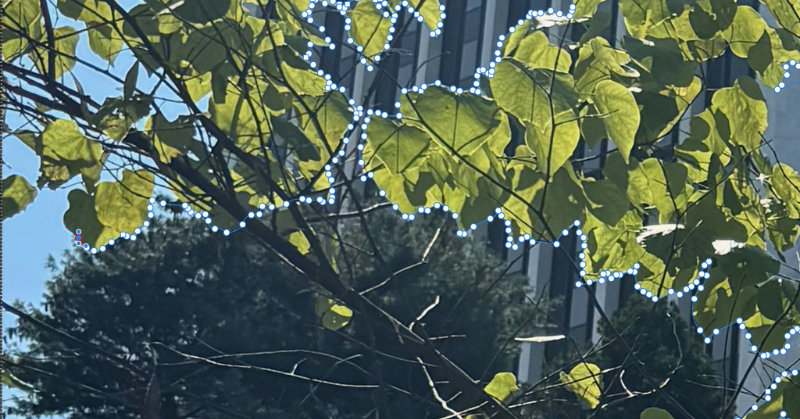
Item. the Chapbook. With the text complete and the cover done, that means, of course, that no. 48 is now available! Patreons and Comrades have received their electronic copies, and paper ’zines of nos. 47 & 48 will be in the post this week; if you’d like your own copy, paper is available here, and electronic copies are available via itch.
Item. Re-runs & premières. Ever since the redesign, that first week of January, 2025, we’ve been re-running the issues, chapters, installments, feuilletons, e-zines, novelettes, episodes, whatever we ought to be calling them, on the regular Monday–Wednesday–Friday schedule, two weeks per, and it’s been just about 88 weeks since then: no. 44, “That was the river—”, is just about done, with the final fit set to appear on Friday the 11th. That’s the end of volume 4, the finale of season two, the last of the previously freely available installments to be re-run, which means next week, Monday the 14th, will see the free world première of no. 45, the first installment of season three! To be followed, of course, by nos. 46, 47, and 48, in regular succession, and then we’re back on the old routine of new installments appearing here for free a month or so after they’re finished.
Item. What’s Next. I need to finalize and normalize all the various ebook editions running around out there in the world, to make sure they’re all taking advantage of all the bells & whistles, and to deal with the aftermath of losing Smashwords, make sure library access is unimpeded, all that sort of pesky nonsense, which shouldn’t I don’t think take too long, which is good, because I’m eager to get to this:

I mean, dang. Isn’t that gonna be pretty?
Oh! And also, of course, the writing of the next novelette, and the one after that—we’re coming up on no. 50 in the next few months, which is a milestone sitting right up there with a twentieth anniversary.
Dang.
Posted 17 days ago.
The first soul I heard before I saw it clacked. A tongue stud against teeth, 1996, behind the counter of a pizza-by-the-slice place, back when pizza by the slice became a bougie affair the way Friends changed American coffee house culture. Her name was Opal. She didn’t become a friend. She was more like a rival. She had flour to the elbow like long white gloves and she clicked that stud while she waited for me to get to the end of a sentence I was in no hurry to get to the end of, because the ordering was the point and the pizza was a formality. “The Pig Kahuna.” Back bacon, thin pineapple, red onion, chopped cilantro, hot honey. I told her how I wanted it built and she built it, layer by layer, with the flat, unhurried patience of a woman dealing cards she knows you can’t afford. The hot honey came last, always last, and she held the bottle at a height that made a thin line of it and I watched the line and she watched me watch it. There are women who will make your food exactly how you asked, and there are women who will make you watch. I ate the slice standing up. I did not taste it once that entire year.
But the packaging. I have liked boobs since I saw them with sentient eyeballs. Not admired. Not appreciated the form. I wanted them in my hands and on my breasts, and I want to be clear about the distinction, because there are women who like breasts the way people like architecture, and there are women who want to press their chest into another woman’s chest until neither of you can tell whose heartbeat is whose. I was the second kind at fourteen, in a Catholic school desk, while a woman with a laminated poster explained the Assumption. Mary going up to heaven, body and soul, assumed whole into the sky, and I sat there thinking about breasts with a focus the Church would have envied. They wanted me to contemplate the mystery of a woman’s body rising and I was contemplating the mystery of a woman’s body, full stop, which as far as I’m concerned, is the same devotion at a different altitude. I confessed a lot of things at that school. Never that. Some sins you don’t give away because they aren’t sins, they’re information, and I was fourteen and already smart enough to know the difference even if I wouldn’t have language for it for another thirty years. I wanted the weight of one in my palm, that specific weight, like holding a water balloon you’re not allowed to drop, and the small stupid thrill of a nipple deciding something on its own.
Posted 30 days ago.
Let’s see: in the first ten years (2006 – 2016), I managed to write twenty-seven novelettes, or about 400,000 words; in the second ten years (2016 – 2026), I’ve managed twenty-one (almost), or about 326,000 words. I’ve slowed down a bit, it seems. —In my defense, that second decade did kick off with Trump 1.0; I only managed six novelettes total during those four dire years. When Biden swept in with his brief interregnum of reason resumed? Remember how we danced in the streets? I managed four novelettes in 2021 alone.
Four novelettes in a year. —When I first began, that seemed like a prudently doable pace: four seasons, two volumes per season, eleven novelettes per volume, at four per year we’d be talking, what, twenty-two years? Twenty-four, twenty-five years, with a little wiggle room, we’d be wrapping up around 2030 or so. Plenty of time for an epilogue.
Instead, it’s been more like just under two and a half per year? Pushing completion out to 2043? 2045, maybe? And I would be how old by then?
(Of course, when I first began, it was gonna be five volumes: a hundred and ten novelettes. I should mention that I trimmed it to four pretty early on for story and structural reasons—not for time. In case you were concerned.)
I should maybe pick up the pace.
Twenty years, though: I’ll see about setting up a reading or two somewhere in the next month or so. And there’s this:

A hardcover edition of vol. 1, to be released on Tuesday, October 13th. It’ll retail for thirty-seven dollars US, and while it’s listed in Bowker and Ingram, pre-orders will largely be up to the whims of individual retailers—but! You can pre-order through me for only twenty-five dollars US, plus whatever shipping and handling: handsomely re-designed, an austerely elegant dust jacket, and the first eleven novelettes of the epic, at nearly a third off the retail price.
And, I mean, you know how important pre-orders are to publishers, and gauging the public’s interest, and determine how much to support and what to do next. There’s three more volumes to do up this nice, after all. Plus another two, in maybe about six or seven years? We’ll see.
Posted 38 days ago.
How do stories come to you? I also make poetry—or at least I write poems—and have not been able to see any difference in my mood when I do these two things. While I’m writing a story, I am subject to a set of tensions indistinguishable from those that overtake me when I write poems. The distinction is most of all technical, because I find the idea of “poetic stories” more horrifying than yellow fever, and I am always very careful that what happens in my stories suggests to the reader a definite structure, a given reality, as unreal as it might seem to the eyes of a newspaper reader and those beings with-their-feet-on-the-ground. (What are feet? What is the ground?) If I find in your stories a fraternity that excites me and makes me want to be your friend, it is precisely the supreme nerve with which you plant your word trees. You plant them without the circumlocution of literarily preparing the ground and “creating an atmosphere,” as if the atmosphere should not be the story itself, the irresistible emanation of that thing that is the story. Henry James is a great short story writer, but his stories are always the children of his novels, submitted to the same previous circumstantial elaboration, that technique of surrounding the reader before unleashing the crux of the story. When you wrote “The Rhinoceros,” you needed only the first (perfect!) sentence to make a person forget he was sitting in an armchair in a second-floor apartment on the Rue Mazarine (a lovely street, believe me) and that in ten minutes someone was going to tell him dinner was ready. The estrangement, the passing into the story, is detonating. You are a lion ant, if lion ants are the ones who make a funnel in the sand so their victims slip down to the bottom. Four words and zap, inside. But it’s worth it to be eaten by you.
Posted 93 days ago.
Colson Whitehead’s first novel, The Intuitionist, was a lively comic fantasy about a New York City elevator inspector named Lila Mae Watson. The book established Whitehead’s intelligence and originality as a novelist, but I wasn’t too excited by the world of elevator inspection, and I was frankly irritated by the author’s choice of Lila Mae as the protagonist. Although it’s technically impressive and theoretically laudable when a male novelist succeeds in inhabiting a female persona, something about the actual practice makes me uneasy. Is the heroine doing double duty as the novelist’s fantasy sex object? Is the writer trying to colonize fictional territory that rightfully belongs to women? Or does the young literato, lacking the perks of power and feeling generally smallened by the culture, perhaps believe himself to be, at some deep level, not male at all? I confess to being unappetized by all three possibilities; and so, fairly or not, I found myself wishing that Whitehead had written about a man.
Posted 138 days ago.
I think “solidarity” is what Freaky Tales would call it, a movie which, believe it or not, I’m actually going to talk about. But again: I’ve given myself permission to write the longest essay anyone will write about Freaky Tales, as an exercise, experiment, statement, and/or self-indulgence; I like writing, and I am enjoying writing this, so I am. But the more I write, the more that length gives permission to anyone who doesn’t want to read it—even encourages them—to close the browser and move on. You’re not stuck with me, after all, the way you have no choice but to see a mural as you drive past it each day. You can go find something you like better and leave me to my fun. The internet is a very different space than a wall, or the running time of a film. It’s essentially unlimited in a very specific way: You can write as much as you want on it, spend as much time and fill as much space on the blank canvas of your word document as your silly heart desires, and no one else’s space will be infringed or diminished by it. Nothing’s keeping you here, and you are as welcome to stay as you are to leave. No one is charging you rent.
Posted 148 days ago.
A sharp eye might’ve noticed some changes to the various outlets listed on the Books page, as other places where: Spectator Books in Oakland has been added, there’s a selection of zines on the shelves there now, so if you find yourself on that side of the Bay, head on over, say hi; and but also, Smashwords has been removed.
Which is rather a shame: I’ve been listed with Smashwords almost since I’ve had ebooks—they were the non-Amazon place I sold non-Kindle editions, aside from directly, myself. —But Smashwords was purchased by and integrated with Draft2Digital, and Draft2Digital has announced two new fees: a new account activation fee of twenty dollars, which is annoying on principal (pay us to allow us to take a portion of the sales you make through us, that’s never a good look) but wouldn’t’ve affected myself; and a maintenance fee of twelve dollars, charged annually to every account that didn’t sell a hundred dollars or more in the previous annum.
Draft2Digital insists the fees are needed to combat genAI slop, but that rationale crumbles at the slightest investigation—the new account fees, perhaps, but the maintenance fee’s a joke in that context: slopsters are going to clear a hundred bucks a year without blinking; that’s why they’re in the game, after all. It’s us handcrafted indie oddballs with no gusto for marketing that will end up paying—in all those years I’d been listed there, I’d yet to clear a hundred bucks total myself, much less per any given twelvemonth. The decision to decamp was easily made.
Ebooks will still be distributed far and wide via Ingram; the loss for me, here, aside from continuity, is some library access, but that can be somewhat remedied by signing up with Kobo, which I might’ve already done, some time ago, I dunno. Who can remember which among the infinitude of available accounts they’ve created as a byproduct of trying to get by in this benighted age. We’ll see.
Posted 153 days ago.
Maya S. Cade
Boots, do you think audiences are ready for the kind of leftist, solution‑oriented art you’re presenting to them?
Boots Riley
I think they’ve been more ready than the media wants us to believe. When I was in high school in the 1980s, they got on the PA system and called me a communist. That didn’t make people afraid of me. It made a lot of them think, “Oh, the government doesn’t like this dude—that must be cool.” That was the “me” decade, supposedly apolitical, but that was my experience. Then after 9/11, my band had an album with the Twin Towers blowing up on the cover—which we’d done before the attacks. Afterward, we were on MTV‑sponsored tours, on Fox News, all that. My bandmates thought I was going to get shot if we went through the Midwest and the South, especially because I was stopping shows to speak openly against the bombing of Afghanistan. Not Iraq—Afghanistan, right after 9/11. Everywhere we went—Montana, Michigan, Florida, Texas—I’d stop the music, say my piece, and get thunderous applause. So much of the job with being in the media is to make you think you’re the most left person in any room, that everyone else is more conservative than you. But that’s not what I was feeling on the ground. Then you had Occupy, which was very radical in its language and its targets, happening in pretty much every town. You look at how people responded to Sorry to Bother You: the thing folks had trouble with wasn’t the politics—it was the horse dicks. That’s what got people. I heard story after story: “My Republican parents loved it.” Later, during the 2020 strikes and other workplace actions, I was getting dozens of messages from organisers saying, “We were trying to convince people that a strike was possible. It wasn’t landing. Then we screened Sorry to Bother You and that flipped the switch.” Workers would be texting, “Equi‑Sapiens, let’s be out,” and using the film as a reference point for real‑world action.
So for me, the question isn’t “Is the public ready?” I start from: the public already knows things are messed up. The public is more open than we’re told. The question I ask myself is: how do I move people emotionally towards imagining something they can do? Not “the” solution, but a solution—something that shifts them from “It’s all hopeless” to “Maybe we can try this.” That’s what I’m after.
—Black Fire: Charles Burnett and Boots Riley in Conversation
Posted 183 days ago.
Miyazawa Iori
This “relationship” doesn’t necessarily have to be “love,” love is one of the things this colossal “something” envelops within itself. I think at this point everyone can agree that the definition of yuri as just “love between two women” is no longer applicable. This “something” that connects two women together is sometimes referred to as an “unidentified enormous emotion.” This concept dates back to around 2016. The better you depict the change in the “emotions,” the more “high-resolution,” the more real the work of fiction will feel. High-resolution yuri is “strong” yuri.
Mizoguchi Rikimaru
Do you theorize that yuri can be classified by its “strength”?
Miyazawa Iori
I didn’t come up with the words “strong yuri,” but I do always strive to write strong yuri. Which is, basically, to depict human beings. Though it’s been said that this is what science fiction have never been good at since time immemorial.
Mizoguchi Rikimaru
But I feel that some authors these days manage to depict yuri without actually depicting humans.
Miyazawa Iori
True... [Both end up glancing at Kusano Gengen sitting in the audience.] But let’s return to the subject at hand.
—Yuri made me human:
interview with Miyazawa Iori
Posted 204 days ago.


