
Between now, and 365 (and one-quarter) days from now, six chapters will have been done (God willing, and the creek don’t rise).
Well maybe God was willing but the creek she rose. Here it is more than a week into the penultimate month and I’ve managed but three dam’ chapters. I keep shipping water like I have been and four won’t be done by Auld Lang time.
I’ve written a paragraph? Of the next number? —But I’m not here to talk about that again. Mostly I think to acknowledge to the City of the City that no things did not go as was hoped, as was promised, that there is better to be done and perhaps next year to do it in. And to reaffirm with a swift kick to my own posterior the importance of sitting down and getting the words out.
No! Sleep! Till Christmas!
You’re a ghost
La la la, la la la la la la
I don’t know; maybe I need to use this end of things more. I’m wary of cluttering this space; there is a balance to be maintained, and while it is perhaps not so delicate as I sometimes fear still one ought not try to fix what probably isn’t broken and all that. The story is what it is and if I wanted to send a message I’d send a message and all that but still we live in the era where the author as such is a commodity as well and King Maw is never satisfied: Content! it bellows. More content! —But I don’t want to start talking more. Not here at least. I mean there’s nothing quite so rank as the smell of an author’s sweat as they try to make damn sure the reader got it. For whatever value of it.
I’m not sure why I suddenly switched subjects like that. There was a plan for this entry, wasn’t there? I don’t know. I just work here.
You’re a ghost
La la la, la la la la la la
Like she says: as soon as you say it out loud they will leave you. Not that I’m really worried about that, about my imaginary toads being gently deflated by tales told out of school. I think maybe I’m just aiming another swift kick: there’s other work to be done which might or might not just help the work hereabouts, and I’ve been dithering on that, too.
Oh but there I go again gesturing vaguely and smiling cryptically and getting up and walking away in a huff at the first pointed question leaving you to—what?
I did mention the Twitter thing somewhere along the way, didn’t I? If you were wondering about the sorts of things I mutter to myself when I’m distracted. Or maybe you weren’t? I don’t know.
I’m the bishop and I’ve come
To claim you with my iron drum
La la la, la la la
La la la la
Ah, forget it, Jake. It’s November.
Posted 5636 days ago.

Of course there are f--ries—just as there is Father Christmas. The trouble comes when you try to make them corporeal. They are fine poetic concepts taking us out of this at times too ugly real world.
Posted 5637 days ago.
Another way to think about these two depictions is to ask whether the universe of the story recognizes the existence of persons. I think magic is an indication that the universe recognizes certain people as individuals, as having special properties as an individual, whereas a story in which turning lead into gold is an industrial process is describing a completely impersonal universe. That type of impersonal universe is how science views the universe; it’s how we currently understand our universe to work. The difference between magic and science is at some level a difference between the universe responding to you in a personal way, and the universe being entirely impersonal.
Posted 5667 days ago.
I never saw the Moonday T-Hows. I have seen the T-Horse, though not in a good long while. And I’ve been to Share-It Square and I can walk down to Sunnyside, though it’s a bit of a hike. —Heck, I was at the city council meeting where Share-It Square got the official approvals and variances and all that other pesky whatnot.
But I never got to see the Moonday T-Hows.
The Next Thursday Teahouse is not by any stretch of the imagination the Moonday T-Hows. (It’s larger, for one thing, and somewhat more permanent; it probably cost about $300 to make, instead of $65.) Nor should my fictional Michael St. John Lake ever no matter how dark the alley be mistaken for the quite substantial Mark Lakeman. —There’s many places where the City of Roses isn’t Portland, and this is one of them, resemblances notwithstanding; Next Thursday comes from a very different place than Moonday, and will do very different things when it goes: they each play very different roles in the city-stories they’re part of. Remember to keep in mind what Mr. Ford said about magic, and always keep an eye on the Duke.
Still. Aren’t they both so pretty, the light streaming out through the reclaimed windows and the branch-framed plastic sheeting like that?
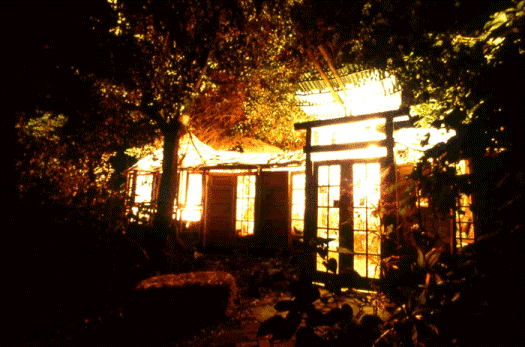
Anyway. A while back—thirteen years ago, oh my—I wrote an article for Anodyne magazine, which is a place to start if you want to see what the Moonday T-Hows did, here in the city of Portland.
Posted 5687 days ago.
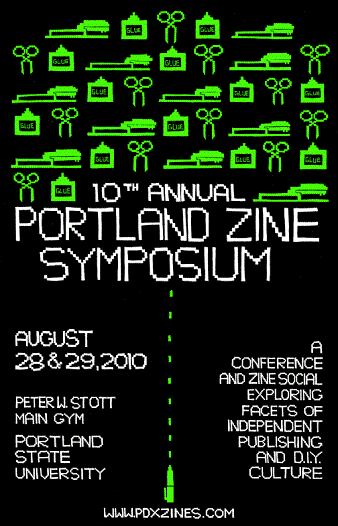
Stepping in briefly to let you all know I’ll be tabling at the Tenth Annual Portland Zine Symposium this weekend (Saturday August 28 and Sunday August 29, 10 – 4) at the Peter W. Stott Main Gym at PSU, with copies of No. 10 and No. 11, plus Nos. 1 – 9 and also some badges and photos and other possible surprises and suchlike. Stop by! Say hi! Check out the glory and the majesty of DIY print culture! Get in out of the partly cloudy weather!
Posted 5712 days ago.
Elsewhere a certain discussion’s begun which may be of some value; though it has not yet managed to hack its way to where we are here, I am assured it should eventually touch on matters of some interest to those who are interested in this sort of thing. (As opposed to that sort of thing. Which one would be by definition. Wait—)
Anyway! The discussion’s currently hingeing around maps, and it so happens there’s a scene upcoming in no. 10 with a map in it. So, then, for you, because you are so good to me, a taste:
“Now that’s what I’m talking about,” says the little guy, coming barefoot from the bathroom, wrapped in a white towel. “Ten hours sleep and this is as close to a vacation as we’re ever likely to get on this gig.” He climbs up onto one of the two queen-sized beds and scoots back against the padded headboard. He reaches for the remote on the nightstand. “Don’t,” says the big guy.
“Don’t?”
“Still tuning up.” His black jacket draped over the back of the chair the big guy’s sitting at the round table by the big picture window at the front of the room. Spread out on the table a map. Plastic letters scattered across the map, refrigerator magnets in bright and simple colors, a yellow Y at the edge of downtown, a blue P over the freeway, a red Q above them, an orange B on the other side of the map away across the river, down by 39th and Hawthorne. In his hand another letter turning over in his thick and hairy-knuckled fingers, another B, a green one. “What’s that for?” says the little guy.
Mr. Keightlinger looks down at the letter in his hand. “Bunny,” he says. He snaps the letter onto the map at the foot of the northern freeway bridge over the river. Mr. Charlock snorts. “You think they’re involved?” Twirling the little sprig of hair curled almost precisely between his brow and the top of his skull.
“Don’t know,” says Mr. Keightlinger.
“Sure we do,” says Mr. Charlock. “It’s Southeast, fucking with Southwest. Mechanicals ain’t even in the mix. I’m telling you, if Leir would just listen to us on this,” and Mr. Charlock leans forward, blotting his forehead dry with a corner of the towel. “Instead of riding us for something proofy he can take to fucking Agravante. Christ, man!” Mr. Charlock slaps the bedspread. “You’re fucking with the vacation vibe here. Put it away so we can watch us some teevee.”
Posted 5729 days ago.
On the one hand, new(ish) forms such as pornography, advertising, video games, and gambling, have taken up the neurological tricks long resident in narrative and brought them right to the profit-generating center of the works produced. On the other hand, literary modernism and its aftermath seems in this light a movement in fiction centered on the disavowal of the technologies of narrative addictiveness: a resistance to the traditional rhythms of plot is combined with a diminishment of the sense of authorial (and thus vicarious readerly) control. The phrase “misjudgment of utility” maps crookedly though provocatively onto, say, Adorno’s discussions of modernism’s uselessly utopian attempts at autonomy. Modernist fiction is that fiction that does not tease you into thinking that you can win. Which is of course better than video slots, but also… perhaps politically pernicious in a deeper sense.
Posted 5740 days ago.
The Rev. Donald Wildmon
American Family Association
Anytown, USA
Reverend—
Hi! How’s it going? —Oh, I know: we have our differences. In fact, you represent pretty much everything I think to be wrong with this world, with the possible exception of business shorts—you don’t wear business shorts, do you?
Good.
Despite all that, I refuse to believe there can be no common ground between any two people. We are people, after all; we have wants, we have needs, we have mothers and fathers, if we’re pricked we bleed, we like extra helpings of whatever it is we especially like to eat. Surely there is somewhere, somehow, some way our interests can be in alignment, and we can work together to the enrichment of us both, and the detriment of neither.
It’s one of those possible alignments I’d like to discuss with you now.
I had the idea when I first read about the boycott you’ve announced of the Home Depot. I will say that I admire your gumption, and your gall, and your persistence, but let’s, just the two of us, be honest with each other for a moment: we both know how this ends. It ends just like your boycotts of Ford, and of Disney, and of Citigroup, of American Airlines and Allstate, of Pepsi and Coca-Cola, of Wal-Mart and Kraft: with a whimper, not a bang. —Oh, you’ll get a flurry of press, and a shower of new donations, thanks to the announcement. And maybe the board of a charity somewhere out there on which a Home Depot executive sits will have to cut a program or let go a staffer due to budget cuts, and you can link that program or that staffer however tangentially to the fight for marriage equality or one of those “gay celebrations” you keep going on about, and you can take credit for that. And then next quarter when the Home Depot announces a drop in revenue that’s all but inevitable in the current economic climate, you’ll take credit for that, too. —And then you’ll announce your work is done, the boycott is now over, and besides you’re on to more important things, like look! Over there!
I’m sorry, Reverend, but the gag’s got whiskers. People are starting to catch on. You need to up your game.
And I and dozens, no, thousands, tens of thousands of writers and artists and musicians and cartoonists and photographers and actors and filmmakers and conceptualists, need—buzz. Publicity.
Attention.
Here’s what I have in mind: you set up a webpage. Nothing fancy, just a simple form attached to a reasonably robust database. The page would allow someone like me to enter the particulars of my project: what it’s called, what it is, how to find it. And then all of the things you might find objectionable about it. You could provide a checklist, to save on typing, and I could just tick off check marks next to occult content, drug use, profanity, explicit sexual content, fluid conceptions of sexuality, suspiciously leftist political cant. Maybe provide a text box so I can paste in some choice excerpts.
You then take the data provided and have an intern whip up a personalized boycott page. “BOYCOTT! The City of Roses promotes the homosexual agenda! Judge for yourself by reading the appalling excerpts below.” —I get shivers just thinking about it.
See, it’s the retail approach. The shotgun approach. The grass-roots autonomous viral heat-seeking meme-thing. Your followers are suddenly exposed to the overwhelming tide of filth out there on the internet, and to your valiant efforts to stem that tide—and, best of all, because art is so often made by starving artists, who run out of health insurance and have to take second jobs and end up delaying, curtailing, or even abandoning projects unfinished from time to time, well—think of all the credit you’ll be able to take! Your success rate will shoot through the roof, and you won’t even have to lift a finger.
And us?
Well, we’ll get to marvel at the surge of traffic and attention and revel in the outpouring of well-wishes and good cheer that come from all over the country whenever you announce one of your boycotts.
It’s a total win-win situation, Reverend.
Think it over.
Posted 5743 days ago.
Irony in this subdued sense, as a generous scepticism which can believe at once that people are and are not guilty, is a very normal and essential method; Portia’s song is not more inconsistent than the sorrow of Helen that she has brought death to so many brave men, and the pride with which she is first found making tapestries of them; than the courage of Achilles, which none will question, “in his impregnable armour with his invulnerable skin underneath it”; than the sleepers in Gethsemane, who, St. Luke says, were sleeping for sorrow; than the way Thesée (in Racine), by the use of a deity, at once kills and does not kill Hippolyte. This sort of contradiction is at once understood in literature, because the process of understanding one’s friends must always be riddled with such indecisions and the machinery of such hypocrisy; people, often, cannot have done both of two things, but they must have been in some way prepared to have done either; whichever they did, they will have still lingering in their minds the way they would have preserved their self-respect if they had acted differently; they are only to be understood by bearing both possibilities in mind.
Posted 5743 days ago.
I’m not ashamed; I admit freely I bought the damn thing for the cover. Because what a fucking cover, huh?
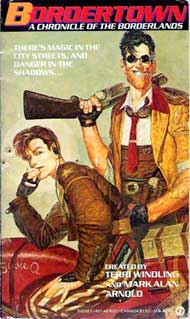
That it was actually a painting in one of the stories in the book, the story I’ll impolitically allow was the best in the book, is just a lovely lagniappe. —Anyway, it’s one of the Books Without Which, along with that dam’ pioneering War for the Oaks; those odd little off-shoots of mightabeen, urban fantasies scrabbling for what light and air they can find these days in the shadow of leather-trouser’d vampires and tramp-stamped lycanthropes.
I swear I had both of the early anthologies, having bought the one on a whim and going back for another, but only the one’s on the shelf these days; them and Finder’s the extent of my travels in the Borderlands, and that was some time ago. —Well, and The Last Hot Time, but that came later, and is more sideways than straight-on; Chicago, maybe and not Minneapolis? —Not that Minneapolis is Bordertown, not all on its lonesome. —I digress. Look!
All the stories are now done, and have been turned in to our publisher, Random House. The book is called Welcome to Bordertown—and that’s also the name of the story that Ellen Kushner and I wrote together for the volume.
So sayeth Terri Windling. And this would be the table of contents; do note the presence of among many other luminaries Sara Ryan and Dylan Meconis, both of them friends of this city, as well. (For inst.) —To be published in 2011.
Posted 5745 days ago.


